

FROM THE FIELD
All week, we've been talking about peer accountability. The fear behind the silence. The conditions that make it harder. The weight of choosing not to speak.
Here's what I know after 22 years in the field and more close calls than I want to count: the incidents that haunt people the most aren't always the ones where they got hurt. They're the ones where they saw it coming and said nothing.
Peer accountability doesn't live in a policy binder. It lives in the space between two people on a crew. In the moment where one of them sees something wrong and has to decide whether to say something or let it go.
Most let it go. Not because they don't care. Because they've been trained by culture, by experience, by fear, to believe that speaking up costs more than staying quiet.
LET’S DIVE IN

Incident Breakdown
THE MOMENT
Two linemen. Same crew for three years. Solid relationship. Trusted each other.
One of them, a journeyman with 15 years in, had a habit. On certain pole-top work, he'd skip a step in his fall protection sequence. Not every time. Just when the job felt routine. When the pole was short. When the weather was good and the work felt simple.
His partner saw it. Every time. He noticed the lanyard wasn't where it should be. He noticed the sequence was out of order. He noticed the small, quiet deviation that had become habit.
And every time, he said nothing.
He told himself it wasn't his place. The guy had more years than him. He told himself it was a minor thing. He told himself the guy knew what he was doing.
One afternoon, on a routine pole, the journeyman lost his grip. His fall protection caught him, but barely. The setup he'd been running, the one with the skipped step, almost failed. He dangled for a few seconds before recovering. No injury. No report. Just a close call that nobody outside the crew ever knew about.
That night, his partner sat in his truck in the driveway for twenty minutes before going inside. He couldn't stop thinking about what would have happened if the lanyard hadn't held. And he couldn't stop thinking about every time he'd watched it happen and said nothing.
THE MISS
This wasn't a system failure. The policy was clear. The training was solid. The equipment was good. What failed was the conversation.
His partner missed the moment. Not because he was careless, but because the culture around him told him to weigh the cost of speaking up against the cost of staying quiet. And every time, staying quiet felt cheaper.
Nobody on that crew had ever modeled what peer accountability looks like. Nobody had ever shown them how to say "Hey, I noticed something" without it turning into a confrontation. The foreman ran a solid crew, but accountability only flowed one direction: top down.
When accountability only goes top down, the guys working shoulder to shoulder never learn to hold each other. And that's where the real exposure lives.
THE FIX
Peer accountability starts with one shift: separating the person from the behavior.
You're not calling out your coworker. You're calling out the risk. There's a difference, and it matters.
Here's what should have happened:
First conversation, the first time he saw it: "Hey, I noticed your clip wasn't in the right spot on that last one. I know it's routine, but let's make sure it's right every time. I'd want you to tell me the same thing."
That's it. No lecture. No report. No drama. Just one sentence between two people who trust each other.
If the behavior continued: "Hey man, I've brought this up before. I'm not trying to be on your case. I just need to know we're both going home tonight."
And if it still continued: "I have to take this to the foreman. Not because I want to get you in trouble. Because I can't watch it happen again and live with what might come next."
That's the escalation path. Respect at every step. But the key is starting. The first conversation is the one that changes everything.
Quick Field Note
I talked to a foreman last year who told me something that stuck. He said, "I used to think my crew had good accountability because nobody was getting written up. Then I realized nobody was getting written up because nobody was saying anything."
That's the gap. Silence doesn't mean compliance. It means people are choosing not to engage. And when your crew stops engaging, you've lost the only safety system that actually works in real time: the person standing next to you.
Toolbox Deep Dive
THE FRAMEWORK: SPEAK UP WITH RESPECT, NOT JUDGMENT
Peer accountability is a skill. It can be taught, practiced, and built into your crew culture. Here's how.
Step 1: Separate the person from the behavior. Don't say: "You always do that." Say: "I noticed something on that last task." Keep it about what happened, not who did it.
Step 2: Use "I" language. "I noticed." "I'm concerned." "I'd want someone to tell me." This removes the accusation and replaces it with partnership.
Step 3: Offer the mirror, not the verdict. You're not there to judge. You're there to reflect back what you saw. Let them decide what to do with it. Nine times out of ten, they'll correct it on the spot.
Step 4: Normalize it in both directions. The best crews don't just tolerate being corrected. They expect it. They ask for it. "Hey, watch my back on this one. Tell me if you see something I don't."
Step 5: Make it a crew standard, not an individual act. At the next tailboard, say it out loud: "If you see something on this job, say something. No judgment. No write-ups. Just say it. That's how we work."
Field Scripts You Can Use Today:
"Hey, can I talk to you about something I saw?"
"I noticed [specific behavior]. I know you know what you're doing. I just want to make sure we're both solid."
"I'd want you to tell me if you saw me doing that. So I'm telling you."
"Something didn't look right to me. Can we walk through it together?"
Want These Tools for Your Crew?
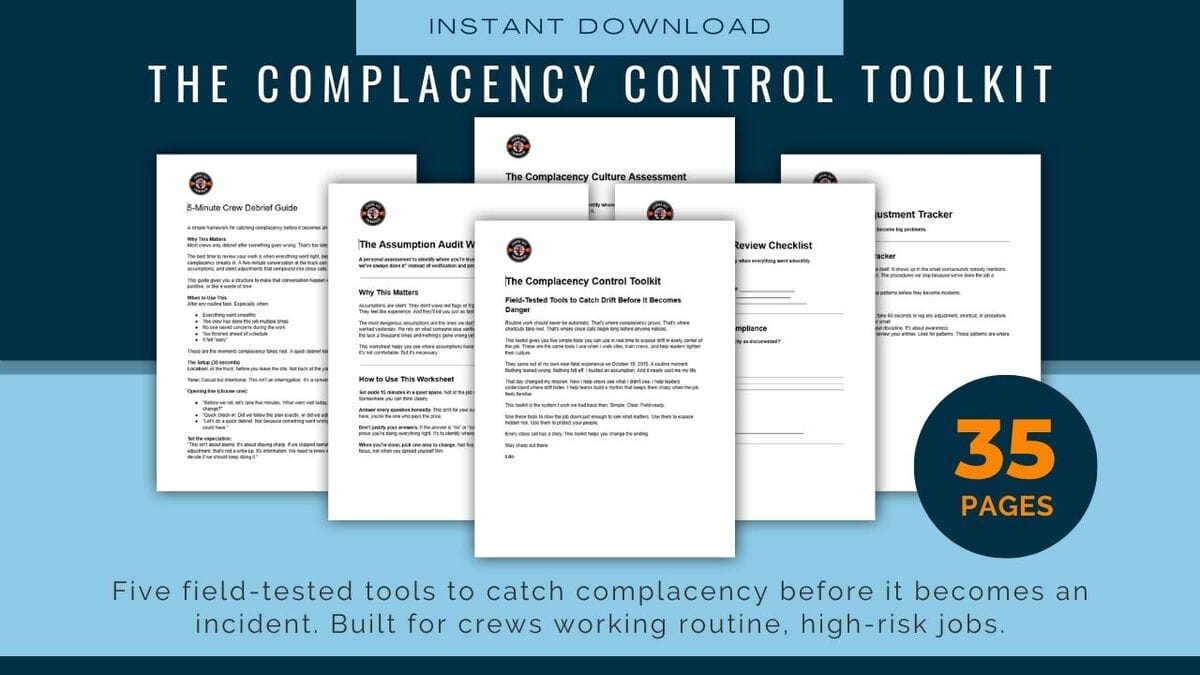
The Complacency Control Toolkit gives you everything in this post plus 4 more tools, ready to print and use with your team tomorrow.
What's inside:
✅ Assumption Audit Worksheet
✅ 5-Minute Crew Debrief Guide
✅ Complacency Review Checklist
✅ Silent Adjustment Tracker
✅ Complacency Culture Assessment
35 pages. 5 complete tools. Field-ready.
Leadership Reflection
For Field Leaders:
Start by modeling it. The next time you catch yourself about to skip something, say it out loud. "I almost skipped that step. Glad I caught it." When your crew sees you hold yourself accountable, they'll start holding each other.
For Supervisors:
Look at your incident and near-miss data. How many of those events had a witness who stayed quiet? That's your peer accountability gap. Address it not with more policy, but with training on how to have the conversation. Role-play it. Practice it. Make it normal.
For Executives:
Ask this question at your next leadership meeting: "Do our crews hold each other accountable, or do they wait for supervision to do it?" If the answer is the second one, you have a structural problem. Invest in peer-to-peer communication training. Reward crews that demonstrate healthy accountability. And stop punishing the people who speak up.
"The hardest conversation you'll ever have at work is the one that keeps someone alive. Have it anyway."
Tailboard Challenge
Tomorrow morning, before the first task, say this to your crew:
"If you see something today that doesn't look right, say it. I don't care who it is or how much experience they have. We're all watching out for each other. No judgment. That's how we operate."
Then mean it.
Want to build a culture where every worker goes home safe?
Let's talk. Reply to this email, or visit www.leadingsafelineworkers.com to book a keynote, training, or consultation. Because safety isn't a program. It's a leadership decision.
Share this with someone who needs it.
Forward this to a foreman, a safety manager, or a crew member who's trying to lead better. Let's build this together.
Until next time,
Lito Wilkins
