

FROM THE FIELD
This week we have been talking about equipment checks. Not the form. The practice. The difference between looking at something and actually seeing it. The difference between documenting a deficiency and doing something about it.
Most crews I work with are good at inspections. They know what to look for. They know the standards. They can spot wear, damage, and degradation. That is not where the system breaks down.
The system breaks down between the inspection and the action. The space where somebody writes it down, somebody flags it, and then nobody closes the loop. The deficiency lives on a form. The gear lives on the truck. And the gap between those two things gets wider every day until someone finds out the hard way.
Today we go deeper.

Incident Breakdown
THE MOMENT
Fall protection inspection. Quarterly cycle. A crew of four was working transmission construction, setting steel and pulling wire. The safety coordinator ran the inspection on a Tuesday morning. Went through every harness, every lanyard, every connector on the crew.
He found it on the second harness. Stitching on the dorsal D-ring attachment was fraying. Not catastrophic. Not torn. But visibly degraded in a way that did not meet the manufacturer's inspection criteria. He tagged the harness with a red out-of-service tag. Wrote it up on the inspection report. Noted the serial number, the deficiency, and the recommendation: remove from service, send for replacement.
He handed the report to the foreman. Told him about the harness. The foreman nodded. Said he would handle it.
Two weeks later, that harness was still on the truck. The red tag was gone. Nobody could say when it came off or who removed it. The foreman said he had meant to pull it but got busy with the project push. The crew had four harnesses for four workers. Pulling one meant someone couldn't climb until the replacement arrived. So it stayed.
On a Thursday afternoon, the lineman wearing that harness slipped during a steel setting operation. Standard fall. The kind the harness is designed to catch. The dorsal D-ring attachment held for the initial shock. Then the stitching failed. The harness separated at the attachment point. He fell nineteen feet to a steel cross-member below. Fractured pelvis. Three fractured vertebrae. Eight months off work. He came back, but not to climbing.
The inspection found it. The report documented it. The foreman acknowledged it. And the lineman fell because nobody closed the loop between finding the problem and fixing it.
THE MISS
We believed the pattern. We ignored the warning.
The truck had been reliable, so we assumed it would stay reliable. The line had held before, so we assumed it would hold again. The inspection passed, so we assumed we were good. We stopped looking for what might change because nothing had changed yet.
Complacency doesn't show up waving red flags. It sneaks in wearing yesterday's success. It sounds like, "This truck worked fine yesterday," or "We've done it this way for years." Those words don't sound dangerous. But they are. That's complacency talking.
The moment we stop questioning, we start assuming. And assumptions don't care how experienced you are. They'll take anyone down if you give them the chance.
THE FIX
An inspection has three parts. Find the problem. Document the problem. Fix the problem. If any one of those three is missing, you do not have an inspection system. You have a paperwork exercise.
When a piece of gear gets flagged, it comes out of service immediately. Not after the project push. Not when the replacement arrives. Now. If that creates an operational gap, that gap gets elevated to the supervisor so the crew gets what it needs without putting a compromised piece of equipment back in someone's hands.
The inspection is not complete when the form is signed. It is complete when the deficiency is resolved.
Quick Field Note
A safety manager told me something after a training I did last year that stuck with me. He said, "We have the best inspection program in the region. Our forms are detailed, our frequency is right, our guys know what to look for. And I just found out we have eighteen open deficiencies from the last quarter that nobody followed up on."
Eighteen. Not because his crews were careless. Because the system captured the findings and had no mechanism to close them. The inspections were thorough. The follow-through was invisible.
We worked together and redesigned the process that month. Every flagged deficiency now gets a name attached to it. Not just what was found, but who owns the fix and by when. He told me six months later that the open deficiency count went to zero. Not because they stopped finding problems. Because they started finishing the job.
That is the difference. Inspection is the beginning. Resolution is the end. Everything in between is where the risk lives.
Toolbox Deep Dive
INSPECTION, DOCUMENTATION, ACTION: CLOSE THE LOOP
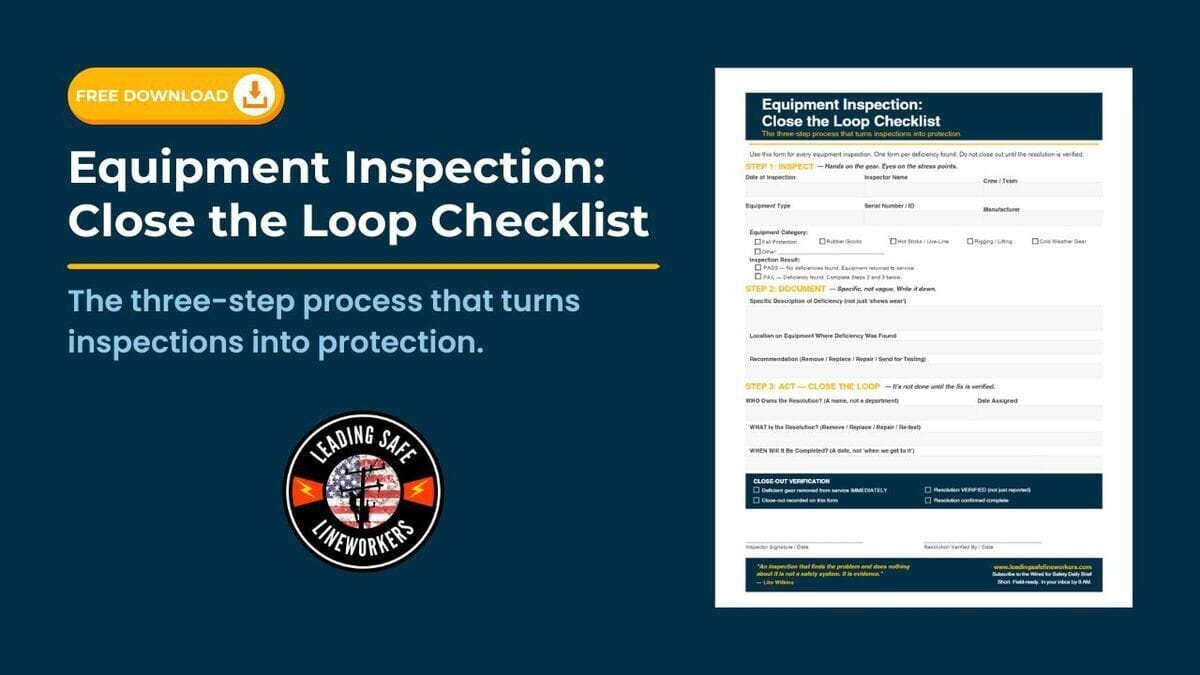
This is a three-step framework for turning equipment checks into actual protection. Most crews have the first two steps down. The third is where the system fails.
STEP 1: INSPECT. Find it.
This is the hands-on, eyes-on evaluation of the equipment. Not the form. The gear. You are looking for wear, damage, degradation, expiration, improper storage, missing components, and anything that does not meet the manufacturer's criteria for continued service.
What to inspect and when:
Fall protection (harnesses, lanyards, connectors, anchorages): before each use and on the quarterly cycle. Look at stitching, webbing condition, D-ring wear, connector gate function, and shock absorber deployment indicators.
Rubber goods (gloves, sleeves, blankets): visual and air test before each use. Electrical test on schedule per ASTM standards. Look for cuts, punctures, ozone cracking, UV damage, and embedded contaminants.
Hot sticks and live-line tools: visual and wipe test before each use. Electrical test on schedule. Look for surface contamination, tracking marks, damage to the fiberglass, and loose fittings.
Rigging and lifting gear (slings, shackles, hooks): before each use. Look for deformation, cracks, wear at contact points, and legible load ratings.
The inspection is physical. It requires touching the gear, flexing the material, operating the mechanisms, and looking at the areas that take the most stress. If your inspection can be done without picking the equipment up, you are not inspecting it.
STEP 2: DOCUMENT. Write it down.
Every deficiency gets recorded. Serial number or identifier. Date found. Description of the deficiency. Who found it. Recommendation (repair, replace, remove from service, send for testing).
This is not optional and it is not just for compliance. Documentation creates the trail that connects the finding to the action. Without it, deficiencies disappear into conversations that nobody remembers the same way.
Two rules for documentation:
First, be specific. "Harness shows wear" is not a finding. "Fraying on dorsal D-ring stitching, approximately 3 of 12 stitches compromised on left side" is a finding. Specificity drives urgency. Vague findings get vague responses.
Second, write the recommendation. Do not leave it to someone else to decide what happens next. If the gear needs to come out of service, say so on the form. If it needs to go for testing, say so. The person doing the inspection is the person closest to the condition. Their recommendation carries weight.
STEP 3: ACT. Close the loop.
This is the step that separates an inspection program from an inspection culture. Every documented deficiency gets three things assigned to it:
Who owns the resolution. A name, not a department.
What the resolution is. Remove, replace, repair, or re-test.
When it will be completed. A date, not "when we get to it."
The deficiency is not closed until the resolution is verified. Not reported. Verified. Someone confirms the gear was removed, the replacement arrived, the repair was completed, or the re-test passed. That confirmation goes on the same form or tracking system as the original finding.
If your inspection program captures findings but has no system for tracking resolution, build one. It does not have to be complicated. A shared log with four columns works: item, deficiency, owner, and resolved date. The tool does not matter. The discipline does.
The accountability question: At your next safety meeting or toolbox talk, ask this. "How many open deficiencies do we have from last month's inspections?" If nobody can answer that question, your inspection program has a gap. Name it. Then close it.
Leadership Reflection
For Field Leaders. You are the last line between a deficient piece of equipment and a worker who trusts it. When something gets flagged on your crew, own the follow-through. Do not assume the safety department will handle it. Do not wait for the replacement to show up on its own. Track it. Escalate it if you need to. And if pulling a piece of gear out of service means you are short on equipment, say that out loud to your supervisor. That is not a complaint. That is risk communication. The operational gap is real, but it is solvable. The equipment failure is not.
For Supervisors. When a foreman tells you a piece of gear is out of service and the crew needs a replacement, that is not a problem. That is the system working. Treat it that way. If your response to a flagged deficiency is pressure to keep working with what you have, you are teaching your crews that inspections do not matter. Get the replacement. Fast. Show your foremen that pulling gear out of service is a decision that gets supported, not questioned.
For Executives. Your inspection program is only as strong as your resolution process. If your organization tracks what gets found but not what gets fixed, you have half a system. Invest in the close-the-loop mechanism. Whether it is software, a shared tracker, or a monthly review of open deficiencies, the tool matters less than the commitment. Every open deficiency is a known risk that your organization documented and chose not to resolve. That is not a training problem. That is a leadership decision.
"An inspection that finds the problem and does nothing about it is not a safety system. It is evidence."
Tailboard Challenge
At tomorrow's pre-job brief, pick one piece of equipment off the truck. Not the newest one. The one that has been in service the longest. Inspect it in front of your crew. Out loud. Walk through what you are checking and why. Then ask, "Has anything been flagged on our equipment that has not been resolved yet?" If the answer is yes, resolve it before the work starts. If the answer is "I don't know," that is the problem. Name it. Then fix it.
Want to build a culture where every worker goes home safe?
Let's talk. Reply to this email, or visit www.leadingsafelineworkers.com to book a keynote, training, or consultation. Because safety isn't a program. It's a leadership decision.
Share this with someone who needs it.
Forward this to a foreman, a safety manager, or a crew member who's trying to lead better. Let's build this together.
Until next time friends,

